Case Study · Scorpio – Fortune Estates
The building that pays its residents back
How a 24-home building in Hadapsar became India's first net energy positive affordable housing project, with a green premium of exactly zero.
- Location
- Hadapsar, Pune
- Completed
- 2019 · 30 months
- Homes
- 24 × 2-BHK
- Green premium
- ₹0
Chapter 01
The challenge
Residential buildings in India faced a fundamental barrier. Rooftop solar could only power common areas, which left every individual apartment entirely dependent on the grid. Residents of green-certified buildings continued to pay full electricity bills.
There was no technology to equitably meter and distribute solar energy to each homeowner in a multi-unit building. That single gap made green certification meaningless at the household level. A "green home" badge on the gate changed nothing on the electricity bill inside.
Chapter 02
The solution
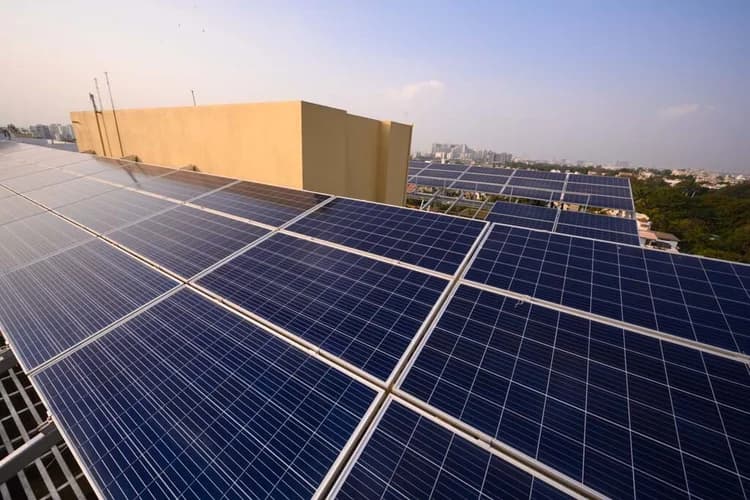
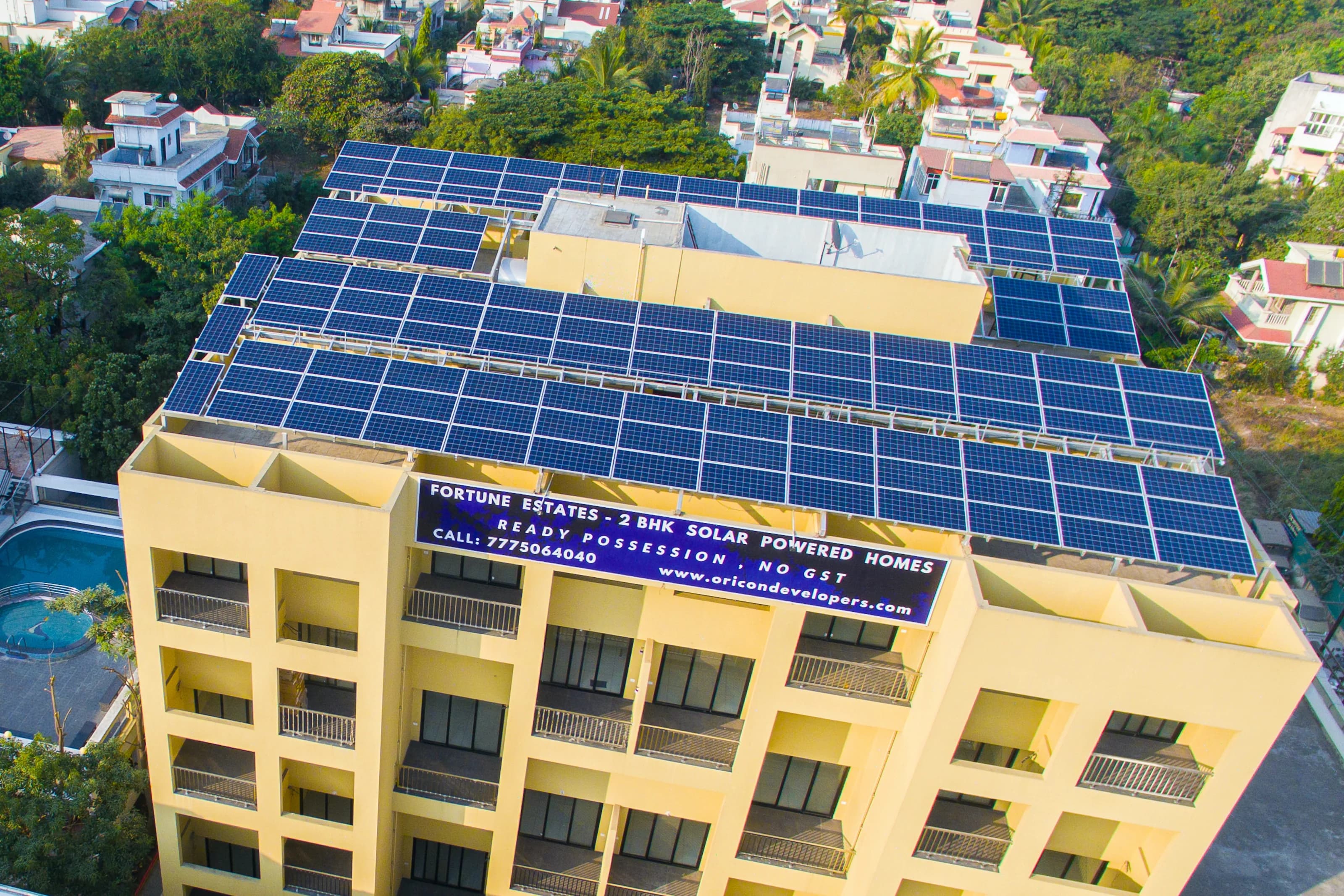
Scorpio, Fortune Estate Building D in Hadapsar, became the proving ground for Protostar's patented SPDU technology. A 41.28 kWp solar PV system covering the entire rooftop generates 66,000 kWh of clean energy annually. The SPDU intelligently distributes this solar power to all 24 apartments, giving each resident 100 free units of electricity every month while letting them draw additional power from the grid as needed.
The project also integrates a CFC-free solar-powered heat pump for 24×7 hot water, EV charging at every parking space, 100% rainwater harvesting and advanced energy metering. Together, these made Scorpio India's first net energy positive affordable housing project.
Chapter 03
The invention: SPDU
The heart of Scorpio is a device that did not exist before this building demanded it.
- 1
The gap
No smart meter available anywhere in India could give an individual apartment its allocated share of rooftop solar while keeping it seamlessly connected to the grid as a fallback.
- 2
First principles
Rahul went back to the drawing board and designed the SPDU, the Smart Power Distribution Unit, from scratch. He built a prototype and tested it in his own home.
- 3
Patent & production
After debugging every edge case, he filed a patent. A manufacturing partnership was set up to produce the units at scale.
- 4
Installed for all 24 homes
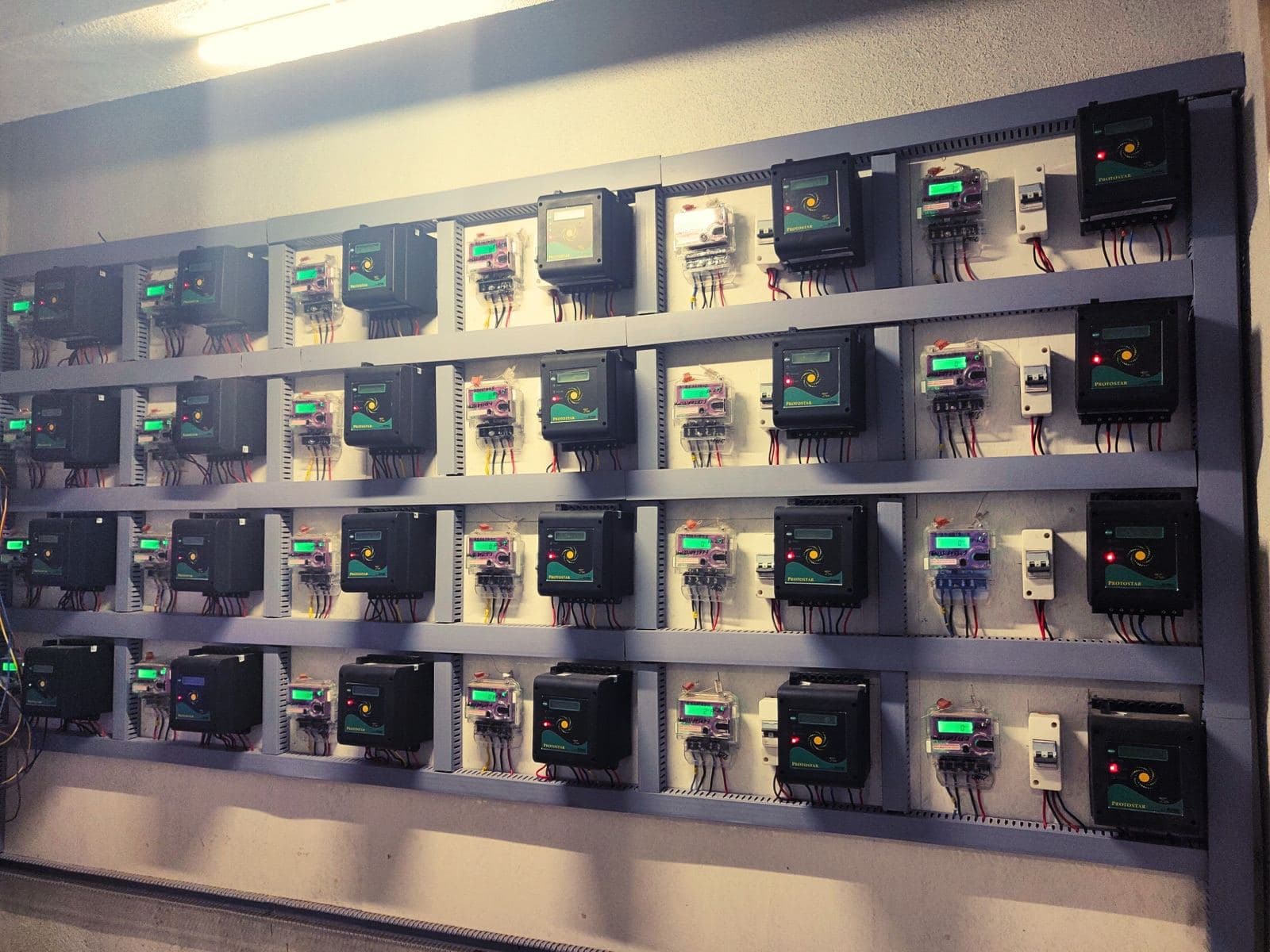
The SPDU bank sits in the ground floor meter room, serving every flat. Each apartment gets 100 free solar units a month. When the quota is consumed, the system switches to grid power silently, with no interruption.
In practice, the quota goes remarkably far. Some residents end up drawing only 10 to 15 additional grid units in an entire month.
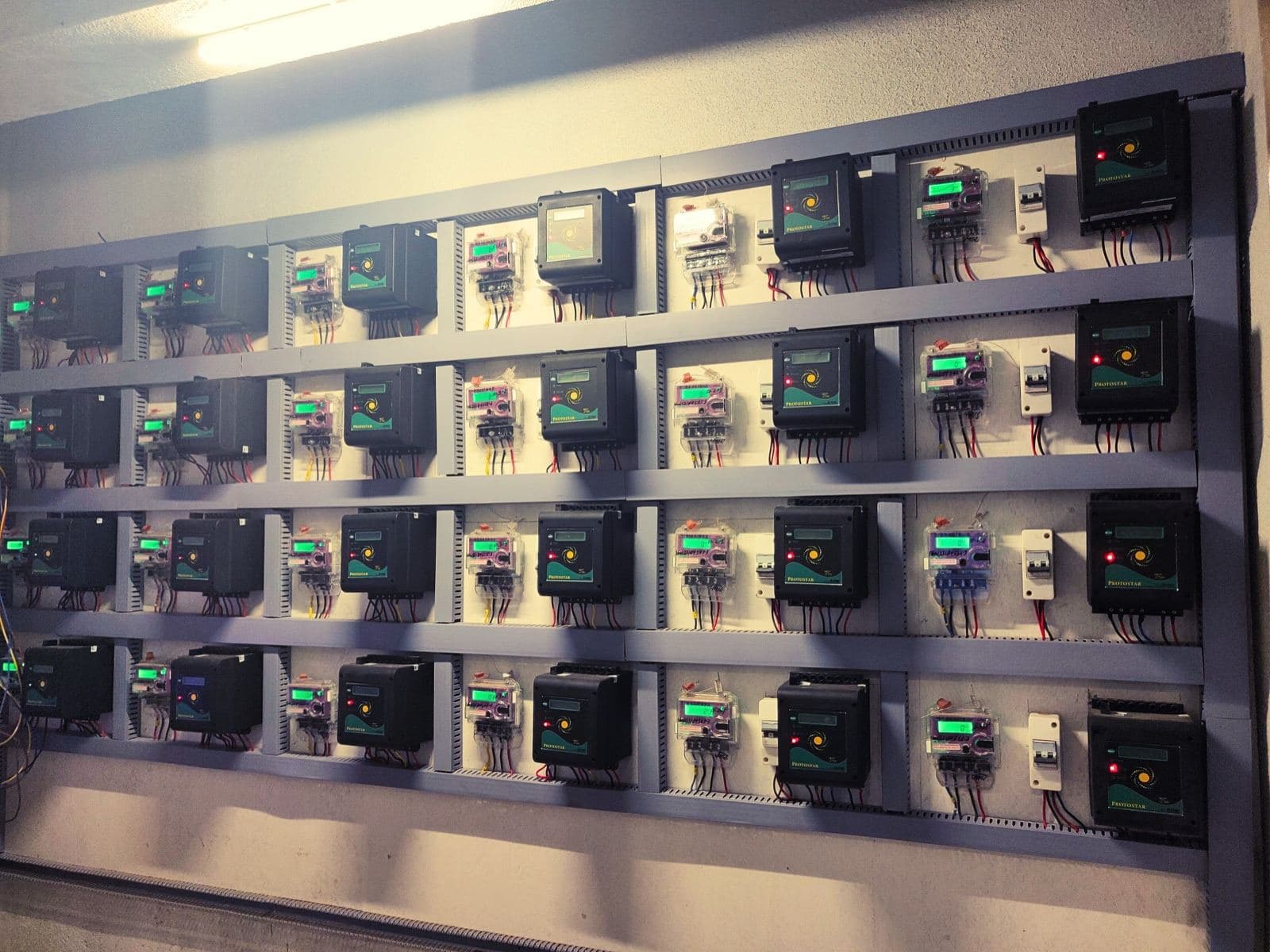
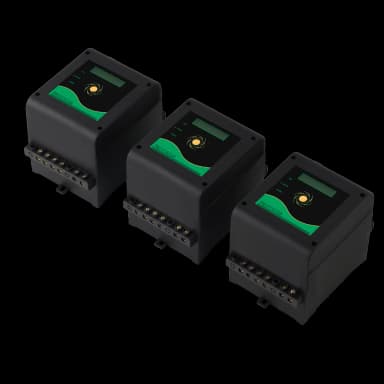
The patented Smart Power Distribution Unit. Solar first, grid as silent fallback, fairness by design.
Chapter 04
No presales. No safety net.
Oricon bore the full construction cost without any presales. Because Scorpio's features were entirely experimental and had never been tested at scale, RERA required waiting for the Completion Certificate before a single unit could be sold.
Both father and son proceeded on conviction alone. Thirty months later, the building stood finished, certified and generating. Every home has since been sold and occupied.
Chapter 05
The results
Measured, audited and independently verified. Not projections. Outcomes.
100 free units/month
Solar per apartment
~50 t/year
CO₂ offset
37.4%
Water use reduction
IGBC Platinum
Green rating
Net Positive
Net energy status
96%
Construction waste diverted
₹0
Green premium charged
The complete numbers, methodology and resident data are in the SPDU Impact Report.
CO₂ offset estimated from the CEA grid emission factor, 0.82 tCO₂/MWh.
Engineering Deep Dive
The details nobody sees, working every day
Beyond the headline solar numbers, Scorpio is a catalogue of quiet engineering decisions that compound.
Passive design
Entire roof shaded by solar panels
Double walls on the east and west faces block afternoon heat gain before it enters the building. The solar array covers the roof completely, so no reflective coating was ever needed up there, while 100% of the non-roof area uses high-SRI surfaces to counter the urban heat island effect. Full shade also flattens the daily swing between peak and low slab temperatures, which cuts the expansion and contraction cycles that fatigue and crack waterproofing, extending the life of the layer beneath. 15% of the site was reserved as green space with natural topography retained.
EV charging since 2019
Every parking bay pre-wired
In 2019, when EVs were still a fringe concept in India, 15-ampere sockets were pre-wired at every single parking bay with clean concealed installation. Residents are now buying EVs because the infrastructure was already there when they needed it.
Energy recovery
80–90% less common-area lighting consumption
Motion sensors on every common area light cut consumption by 80–90%. The elevator's regenerative dynamo converts the kinetic energy of a descending cab back into usable electricity, fed straight into the building's supply.
Water: every drop accounted for
37.4% water use reduction
Dual-sedimentation rainwater harvesting recharges the groundwater table via borewell injection. Ultra-low-flush WCs use 4L/2L against the 8L/6L industry standard of the time, and every tap and shower has built-in low-flow aerators.
Construction circularity
96% of construction waste diverted
12,809 of 13,328 kg of construction waste was reused, recycled or diverted from landfill. 52% of materials by cost were sourced within 400 km, 20% had recycled content, and 100% of wood came from rapidly renewable species.
Waste operations
50 kg/day on-site composting
An organic waste composter handles 50 kg of biodegradable waste daily, reused as landscaping manure. Every home has segregated bins, and a shared facility manages e-waste, batteries and lamps separately.
“Once homebuyers understand the lifecycle savings from green building features, their concern about paying a premium will change entirely. Scorpio proved it's possible to make solar energy truly individual and truly free.”

Rahul Rajan
Director & CTO, Oricon DevelopersFounder, Protostar Technologies
Recognition
Seven awards. Two independent studies.
Scorpio's results were validated by certification bodies, juries, a development finance programme and a Harvard-published academic case.
2019
IGBC Green Homes – Platinum
Indian Green Building Council · Hadapsar's first Platinum-rated residential project
2020
AESA Award: Special Jury Recommendation, Green Initiatives
Architects Engineers & Surveyors Association
2020
Times Real Estate Icons: Top Environment Friendly Project, West India
Times Group
2021
Bharat Leadership Award: Green Entrepreneurship in Real Estate
Presented by the Governor of Maharashtra
2021
National Commendation: Performance Challenge for Green Built Environment
Indian Green Building Council
2022
WIDE Angle Forum Award: Best Standalone Multi-tenement Building
WIDE Angle Forum
2022
SUNREF India: Among India's Top 11 Green Affordable Housing Projects
Agence Française de Développement · European Union · National Housing Bank
What Scorpio Started
One building took 30 months. The idea now takes 3.
Hundreds of thousands of residential buildings across India have bare rooftops. Their residents pay full electricity bills while their waterproofing degrades under unshielded sun.
The SPDU, invented to solve Scorpio's solar distribution problem, can retrofit any existing building in roughly 3 months. No reconstruction, no disruption. That possibility became Protostar Technologies, our technology venture.
Read the study. Then come see the proof.
The rooftop, the meter room and the residents are all real, and all in Hadapsar. Site visits by appointment.